

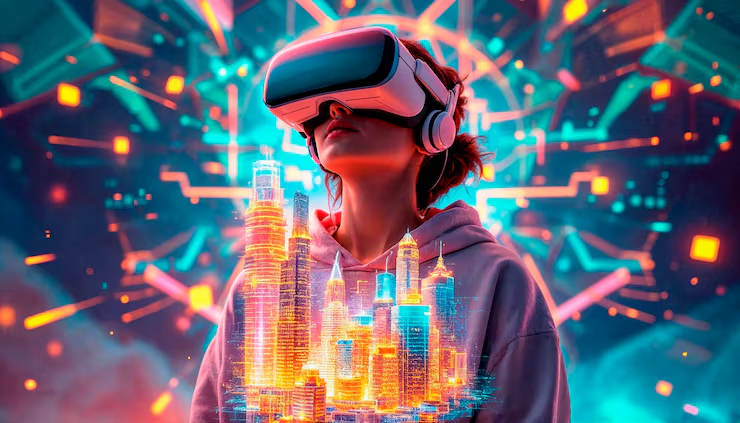
The smartphone has been an indispensable part of modern life for over a decade. From communication and entertainment to productivity and navigation, smartphones have revolutionized the way humans interact with the world. Yet, as innovation accelerates, tech giants are increasingly envisioning a future beyond smartphones. This shift signals a transformative era where wearable technology, artificial intelligence (AI), augmented reality (AR), and other emerging technologies could redefine human interaction and connectivity.
The Limitations of Smartphones in the Modern Era
Smartphones, while powerful, are approaching a plateau in terms of functionality and innovation. Many consumers now feel that upgrades are incremental rather than revolutionary. The limitations of smartphones include:
- Screen Dependency: Smartphones require constant visual attention, which can strain eyes and reduce multitasking efficiency.
- Battery Life Constraints: Despite advancements in battery technology, heavy users often need daily charging.
- Physical Size Limits: There’s only so much functionality that can fit into a handheld device without compromising portability.
- Security and Privacy Risks: Centralized storage of sensitive data in smartphones makes users vulnerable to hacking.
- Environmental Impact: The production and disposal of smartphones contribute to e-waste and environmental degradation.
Recognizing these constraints, tech companies are exploring alternatives that could enhance mobility, reduce dependency on handheld screens, and provide more seamless integration into daily life.
Wearable Technology: The Next Frontier
Wearables are rapidly emerging as a key technology poised to replace or complement smartphones. Smartwatches, AR glasses, and health trackers are just the beginning. Companies like Apple, Google, and Samsung are investing heavily in devices that not only offer convenience but also collect valuable health and behavioral data.
- Smartwatches have evolved from simple notification devices to powerful mini-computers capable of running apps, monitoring health metrics, and even making phone calls.
- AR Glasses promise to overlay digital information onto the physical world, transforming navigation, shopping, education, and gaming experiences.
- Fitness and Health Trackers are moving beyond step counting to advanced diagnostics, potentially predicting illnesses before symptoms appear.
The adoption of wearables indicates a shift towards a more immersive, hands-free digital experience where the smartphone becomes just one of many devices in an interconnected ecosystem.
Artificial Intelligence: The Brain Behind the Devices
Artificial intelligence is a driving force behind the evolution beyond smartphones. AI enables devices to learn user behaviors, anticipate needs, and provide real-time solutions. Virtual assistants like Siri, Google Assistant, and Alexa are only the tip of the iceberg. Future AI systems could:
- Anticipate user actions and automate routine tasks.
- Personalize information delivery based on context, location, and preferences.
- Enhance AR experiences by providing intelligent overlays in real-world environments.
- Integrate seamlessly with wearable devices, vehicles, and home automation systems.
Tech giants are envisioning AI as the central intelligence that will orchestrate multiple devices and platforms, reducing the reliance on a single handheld device.
Augmented Reality and Virtual Reality: Expanding Human Perception
Augmented reality (AR) and virtual reality (VR) are redefining how humans experience digital content. AR, in particular, has the potential to reduce our dependence on smartphones by projecting information directly onto lenses, glasses, or even contact lenses. This can transform the way we shop, learn, and communicate.
For instance:
- AR navigation systems could project directions directly into your line of sight.
- Virtual meetings in AR/VR could replace endless smartphone video calls, creating more natural and immersive interactions.
- Entertainment and gaming could move from handheld screens to fully immersive environments.
VR, while more immersive, could also replace smartphones for certain tasks, especially in fields like design, training, and remote collaboration.
The Role of 5G and Beyond in a Smartphone-Lite Future
High-speed wireless networks like 5G are essential for a future beyond smartphones. 5G provides the low latency, high bandwidth, and reliable connectivity needed for seamless AR, VR, and AI-powered experiences. Tech giants are already exploring applications such as:
- Cloud-based computing where heavy processing is done off-device, reducing the need for powerful handheld hardware.
- Real-time AR overlays for navigation, education, and entertainment.
- Smart city and autonomous vehicle integration that keeps humans connected without relying on smartphones.
With 6G and next-generation networks on the horizon, the possibilities for connected, wearable, and immersive technologies will expand even further, making smartphones less central in our daily lives.
The Evolution of User Interfaces
One of the most significant shifts in a post-smartphone world is the evolution of user interfaces. Voice commands, gesture controls, eye-tracking, and haptic feedback are changing how we interact with devices. This evolution reduces the dependency on touchscreens and introduces more intuitive, natural interactions.
Examples include:
- Voice-activated commands for controlling multiple devices.
- Gesture recognition for operating AR or VR environments without physical controllers.
- Brain-computer interfaces (BCIs) that could allow users to control devices with neural signals.
These interface innovations signal a world where humans interact with technology in more immersive and instinctive ways, leaving the traditional smartphone interface behind.
Challenges in Moving Beyond Smartphones
While the vision of a smartphone-free future is exciting, several challenges remain:
- Consumer Adoption: People are deeply accustomed to smartphones, and convincing them to adopt entirely new ecosystems may take time.
- Privacy Concerns: More connected devices mean more data collection, raising privacy and security issues.
- Cost and Accessibility: Cutting-edge wearables and AR/VR devices can be prohibitively expensive, potentially creating a digital divide.
- Interoperability: Ensuring different devices and platforms work seamlessly together is a technical and logistical challenge.
- Battery and Power Solutions: Wearable devices and AR glasses need compact, long-lasting batteries to be practical for daily use.
Tech giants are investing heavily in research and development to address these obstacles, knowing that the transition away from smartphones will require innovation in both hardware and software.
Companies Leading the Charge
Several tech giants are pioneering the vision of a post-smartphone era:
- Apple is exploring AR glasses and enhanced wearable technology, while integrating AI across devices to create a unified ecosystem.
- Google has invested in AR and VR platforms, AI-driven services, and cloud-based solutions that minimize the need for powerful handheld devices.
- Samsung is advancing foldable devices, smartwatches, and wearable AR concepts that blur the line between smartphone and wearable tech.
- Meta (formerly Facebook) is heavily invested in VR and AR, aiming to create immersive virtual worlds through its Metaverse initiatives.
These companies are not just imagining a future beyond smartphones—they are actively building the infrastructure, ecosystems, and devices to make it a reality.
The Social and Cultural Impact
A future beyond smartphones will fundamentally alter society. Potential impacts include:
- Reduced Screen Addiction: Wearables and AR may reduce the constant scrolling and social media dependency associated with smartphones.
- Enhanced Productivity: Hands-free devices could allow for more efficient multitasking.
- New Forms of Communication: AR and VR could create richer, more immersive social interactions.
- Health and Wellness Improvements: Wearables could monitor health metrics more effectively and promote preventive healthcare.
As smartphones fade into the background, technology will become more integrated with daily life, potentially creating a healthier, more connected society.
Conclusion
The smartphone revolution has defined the past decade, but tech giants are already looking beyond it. With wearables, AI, AR/VR, and next-generation networks, a future where smartphones are no longer the center of our digital universe is not just possible—it is imminent. While challenges remain, the potential benefits in terms of convenience, immersion, and connectivity are immense. The evolution beyond smartphones will redefine human interaction with technology, offering a glimpse into a more integrated, intuitive, and intelligent digital world.